
Three things in life are a certainty: taxes, death and trains being promised for Christchurch in the lead-up to an election. In 2013 and 2017 Labour promised them. The Greens promise them basically every election. NZ First is jumping on board this election.
I’ve seen a bit of ensuing discussion around it so I thought I’d jot down my thoughts on what the rail landscape looks like from my perspective. Most of this I’ve said before in other posts but I’ll try bring it together in one place.
Passenger rail has existed in Christchurch before. As others have written about, Christchurch used to have heavy rail services connecting it to satellite towns and the wider district, and trams proving urban transport. The last tram was pulled out in the 1950s and the last passenger service in the 1980s, with the exception of a handful of tourist-targeted services.
There have been several technical reports published since, looking at the feasibility of bringing them back: 2014, 2017, 2020, 2023. The salient points from these, in my view, are:
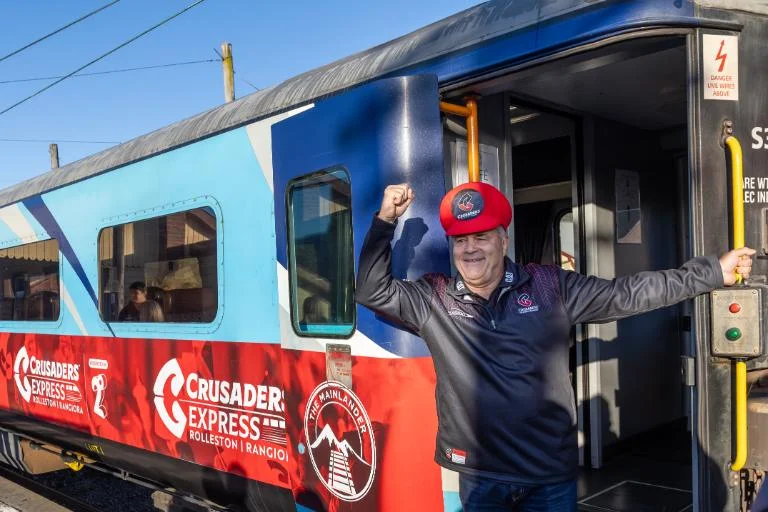
- You can get a bare bones rail service up and running relatively cheaply and easily, using existing facilities. This was proven recently by the private enterpise “Crusaders Express”.
- Although inexpensive, this service would be crappy. Passengers would have to board using ramps as there aren’t operational stations anymore. It would be low frequency, have few stations, and would not service the highest demand areas e.g. the central city. As such, it most likely wouldn’t attract huge ridership.
- There are ways to improve this, but unfortunately they are not that cheap or easy. To get a really useful service that would carry high volumes of people such that it would have a material benefit for the city, it would need:
- Higher frequencies. This means we’d need to double-track the northern line. There is mostly space to do this if we remove the railway cycleway, although there are some pinch points e.g. the recently built Mitre10 Mega. It would also need a new Waimakariri bridge.
- More stations. There’s only one operational station on the line, at Addington. There are a few mothballed stations we could probably fix up without too much cost e.g. Rolleston, Rangiora, Papanui. In some locations we’d need to build brand new ones, e.g. Hornby and Kaiapoi. These would be more costly and difficult.
- Central city station. The biggest problem with heavy rail in Christchurch has always been that it doesn’t get into the central city. It skirts around the outside, roughly 1.0-1.5km from the destinations most people would be going to. The 2023 business case looked at extending the railway line into the central city along Riccarton Avenue in a trench. This greatly increases the usefulness of the service, but also the cost.
These issues are all part of the reason that the 2023 MRT business case recommended that the Greater Christchurch partners (NZTA, CCC, ECan, SDC and WDC) focus on a street-running system along Riccarton and Papanui Roads. It’s a lot easier to get it right into the central city, and is a better option if the goal is to service the most urbanised areas like Riccarton, University, Merivale and Papanui.
The business case also considered doing both street-running and heavy rail at the same time: a high-frequency, high-volume street-running service between Hornby and Belfast, complemented by a minimalist commuter heavy rail service to the satellite towns Rolleston, Kaiapoi and Rangiora. This stacked up somewhat respectfully with a benefit cost ratio of 1.1 – not huge, yet higher than most of the big roads the government are currently trying to build. The idea was that central city passengers would transfer at a specially-built Riccarton station onto the street-running MRT for the last km into town. This transfer point would also be handy for people heading west to the university or airport.
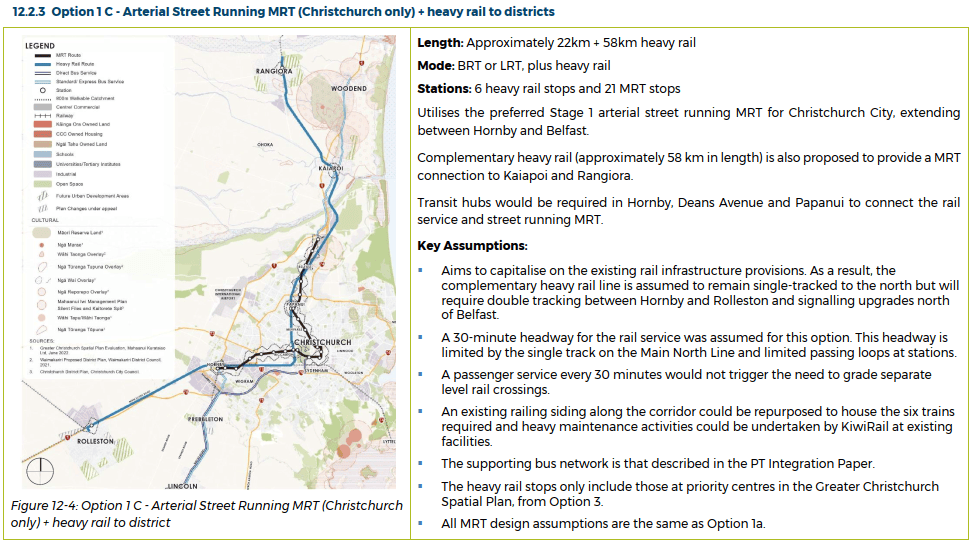
I always thought this option had merit from a transport planning point of view – plenty of other cities follow this kind of 2-rail solution. I think it was discounted mostly from a pragmatic point of view – getting one form of rail off the ground is going to be hard enough for the city’s leaders, let alone two.
I don’t think heavy rail is a dumb idea, but if we do end up pursuing it I think we need to do it properly. I’d hate for us to trial a bare bones rail service, have no one use it because it’s too crappy, then have rail dismissed as uneconomic for the next 30 years. We need to actually spend some money to get proper stations up and running, and we need to decide what we’re doing in the central city. I’m not sure of the best solution but I think one thing is clear – a Moorhouse Ave station can’t be the long-term plan to service the central city.
That’s how I see it anyway: I know others have differrent views. Let’s see what happens in a couple of weeks time!

