There are a lot of good reasons why a city should make sure its streets work well for people on foot, bike and bus: making our city cleaner, greener, safer, healthier, quieter, cheaper and more pleasant to name a few.
But in this post I want to talk about one other reason – capacity.
I think there’s an analogy to be had with the progression of internet connectivity. I may be revealing my age here, but if you’re older than about 40 you’ll remember the days of dial-up internet. This used the old copper telephone wires to bring data into your home, allowing you to check emails, view some very basic websites, and send short strings of text back and forth with others in a messaging application. Initially this was seen as a massive leap forward, but very soon people started getting frustrated by the limited capacity of the copper wires – typically users could access less than 0.01 mb per second. If you wanted to view an image you might have to wait several minutes minutes for it download; and you wouldn’t even think about trying to watch a video!
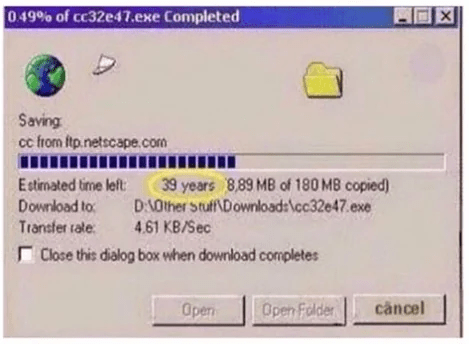
Then in 1999 the the first broadband plan arrived in NZ. These still used the old copper telephone wires but using better protocols significantly increased their capacity to transmit data at ten times the speed: about 0.1-0.2 mb per second. This was a big leap forward but, again, within a few quick years the limitations of this also became increasingly frustrating as people began wanting to do things like stream TV, play online games, and work remotely. By the late 2000s typical broadband speeds had increased another order of magnitude to 3-4 mb per second.
In 2012 the government decided it was in the public interest to rollout a nationwide fibre optic network. This blew everything else out of the park with most homes now being able to get access to something in the the order of 8,000 mb per second. (mostly sourced from good old wikipedia: https://en.wikipedia.org/wiki/Internet_in_New_Zealand#History)

To me it’s notable that, when the copper wire network ran out of capacity, no one was arguing that all we needed to do was keep putting more and more copper wires into the ground: try and provide maybe 2 or 3 or even 4 copper wires into each house. No, it was very obvious that what we needed was a whole new system that was designed for modern internet, with a capacity that was orders of magnitude greater than any copper network could ever provide.
I think this is analogous to our roads. Currently we have a very low capacity road network based primarily on shifting cars around – it’s the equivalent of dial-up internet. A standard 2-lane road with at-grade intersections can only shift 1,000-2,000 people per hour per direction. This might be sufficient: provided hardly anyone lives in your city and they’re all happy to not travel much.
But if you have a city where there are lots of people, and they do want to travel lots, then you need a different system. You don’t want to constrain people’s behaviour by only giving them an extremely low capacity system – you want people to be free to move around and do their thing, you want the population to be free to grow if it wants, the economy to be free to flourish. For context Greater Christchurch is currently growing by about 5,000 people every year. If we try to deal with this by just adding in more low-capacity traffic lanes all over the city, it will be costly, disruptive, and ultimately futile – it can only ever increase the overall capacity of the city very marginally. It’s the equivalent of trying to keep up with increasing internet demand by putting in more copper wires everywhere.
Another option is to switch to a new higher-capacity protocol: the equivalent of broadband. A bus-lane can shift an order of magnitude more people than a traffic lane: around 10,000 people per hour per direction. They can use the existing roads – essentially you just paint one of the traffic lanes green and you instantly increase your people-moving capacity tenfold. Cycleways are similar – again they can shift somewhere around 10,000 people per hour per direction in and again you can build these extremely easily by just repurposing a traffic or parking lane.
The fibre optic equivalent for transport is mass rapid transit. Bus rapid transit can shift 10,000-20,000 people per hour, light rail 20,000 odd, and heavy rail a whopping 90,000. An MRT system would be as much of a game-changer for the the way people move around Christchurch as fibre optic cables were for internet usage.
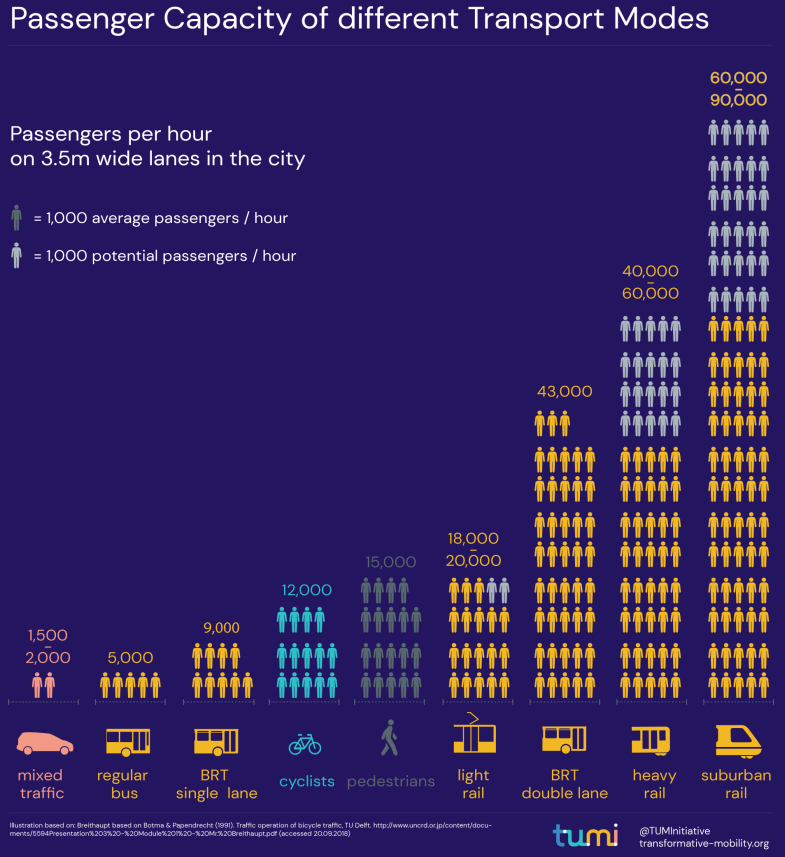
https://transformative-mobility.org/multimedia/passenger-capacity-of-different-transport-modes/ (caveat: lots of different versions of this diagram exist all with slightly different numbers, but the same overall trend for capacity to increase as you move away from cars into walking, cycling and public transport)
Below is a map I’ve put together showing our current low-capacity network in blue, together with where I think we should be going with our medium and high capacity networks in yellow and pink. Most of these are the same as the offical plans but I’ve chucked in a few wee personal additions as well.
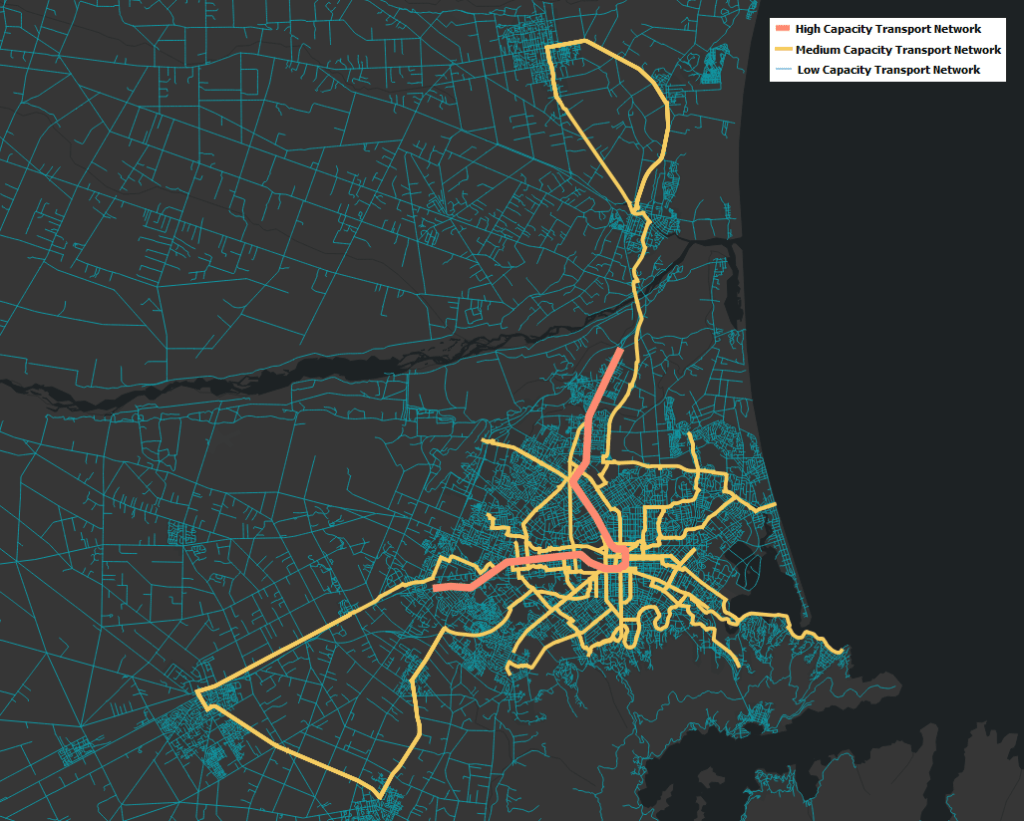
If you’re sick of Christchurch being stuck on dial-up and want to get supercharged with fibre-optics – then get in and support the cycleway and public transport network rollouts in your area!
 TALKING TRANSPORT