Tim Frank
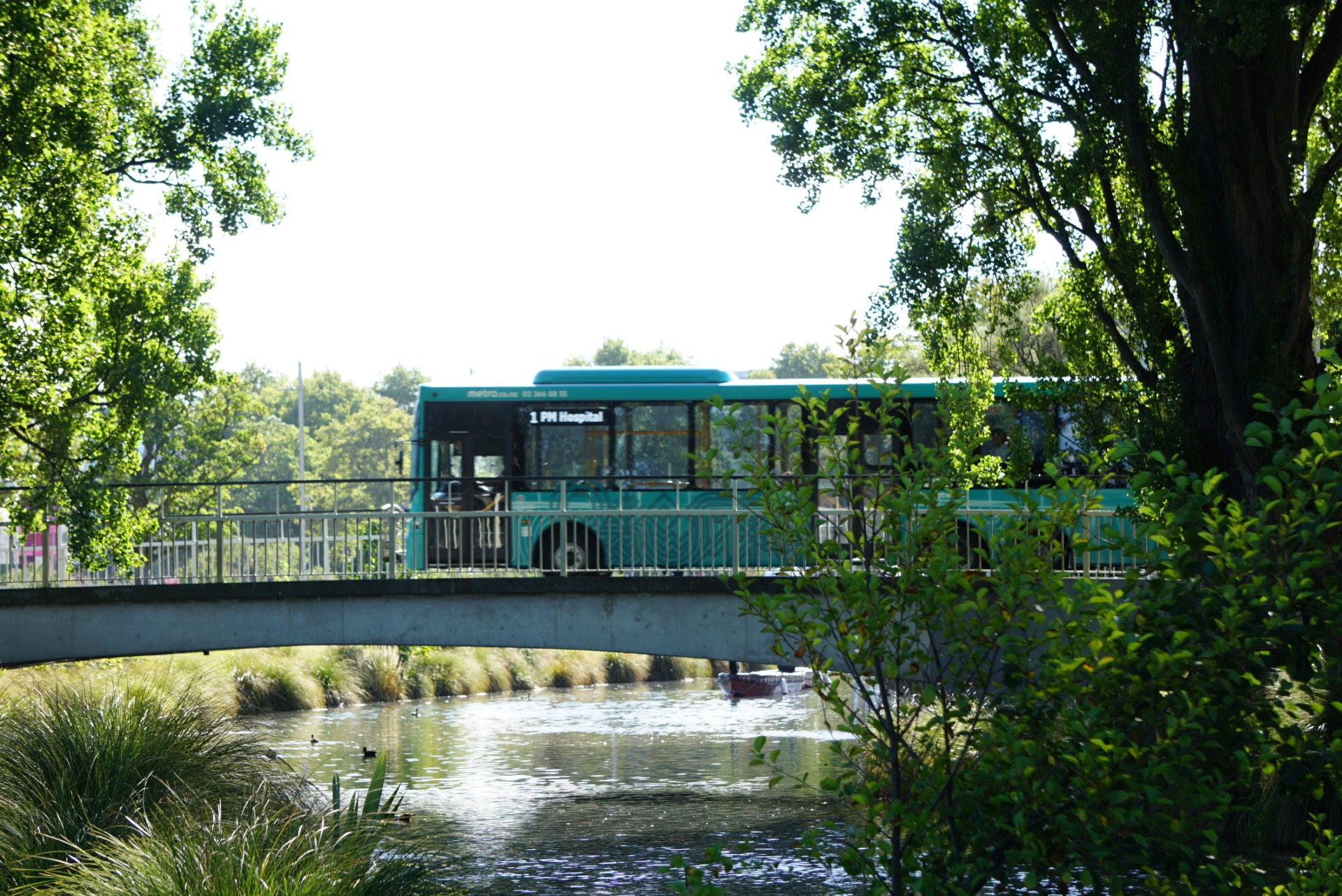
Bunching is a common issue with any public transport system that is reliant on buses, even more so if those buses travel considerable distances of the route in general traffic. So it is little wonder that many bus routes in Christchurch also have significant bunching issues, particularly the more frequent routes. Instead of having a bus turn up every 10 minutes, for example, no bus may arrive for 25 minutes and then three buses turn up all at once. The issue is well-known on the Orbiter route, but I have also observed it on others such as Route 44, when three buses turned up all at once—the first 40 minutes delayed, the second 20 minutes delayed and the third on time. Clearly, having a competent dispatcher who can make decisions on skipping stops would be helpful in those instances.
But there is one bus route in Christchurch where bunching is clearly timetabled in. That is Bus Route 1 between Rangiora and Cashmere. Many of the buses normally run between Rangiora and Princess Margaret Hospital or between Belfast and Cashmere. That means that they overlap in the central section between Belfast and Princess Margaret Hospital, one of the busiest corridors in Christchurch, so that during most times a bus is scheduled to arrive every 15 minutes. During peak hours many buses just run between Belfast and Princess Margaret Hospital, with the buses to Rangiora running express between Belfast and the Bus Interchange in the peak direction.
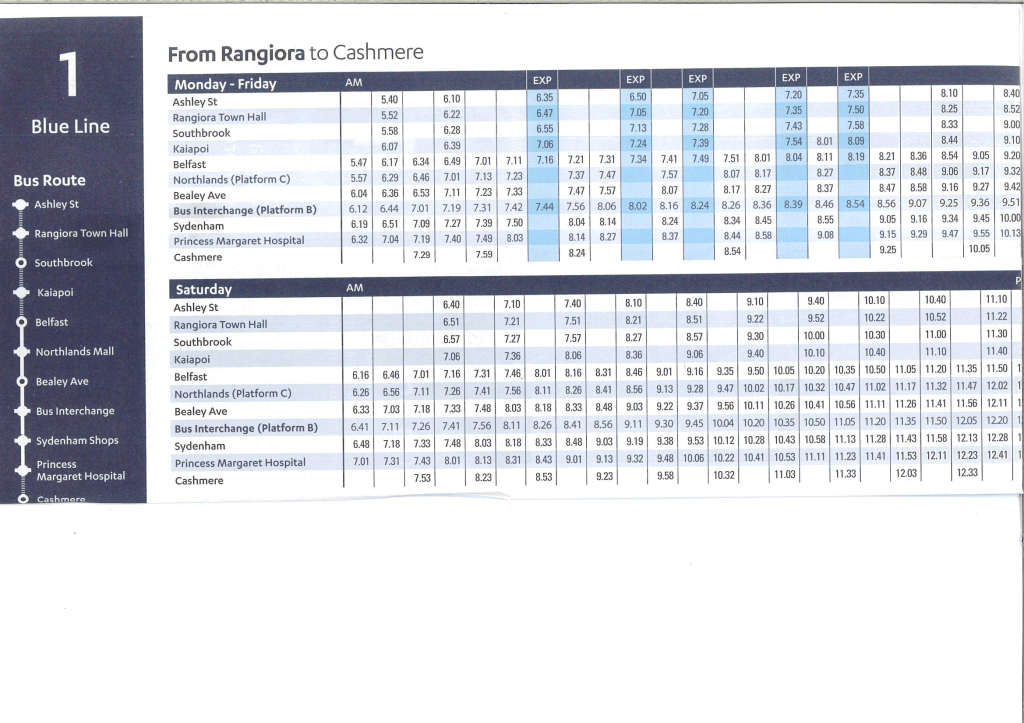
So that’s the schedule in theory. But in practice the buses do not arrive every 15 minutes, but rather two buses turn up every 30 minutes, particularly southbound. That’s because buses from Rangiora normally arrive late in Belfast, getting more and more delayed on the way into town. By the time they reach Merivale, the two buses often are right behind each other, so that from there southwards they run at similar times. Once an hour further the 95 bus joins the bus stop dance, also picking up and setting down passengers along Papanui Road and Manchester Street.

The bunching is not as bad northbound, but often the Rangiora buses leave Princess Margaret Hospital slightly late, due to the late arrival of the previous service. Instead of having a bus every 15 minutes, southbound Route 1 normally offers two buses every 30 minutes. It is therefore not a frequent route. When I use the Number 1 bus to get into the city centre from Northwest Christchurch, I tell people that I prefer appointments at quarter past or quarter to the hour, rather than on the hour or half past the hour.
I and many others who live in Northwest Christchurch would prefer to have a more frequent service. There are several options to achieve this.
- Allow more time in the schedules between Rangiora and Belfast. That might make the buses more punctual. While it officially would lengthen the already long journey time between Rangiora and the city by an additional 5 minutes, the actual journey time would be less than it is now. Passengers might get somewhat restless having to wait in Belfast, if a bus does arrive there early.
- Disentangle the urban section of Route 1 from the metropolitan section. Route 1 could travel between Belfast and Princess Margaret Hospital / Cashmere. A new route could partially take over from peak-hour Route 92 and travel direct from Cranford Street to Kaiapoi and then Rangiora. This would require a transfer bus stop to be built in northern Cranford Street, so that passengers could transfer to the Orbiter to connect to Northlands and other locations in Northwest Christchurch. Additional connection between Kaiapoi and Northwest Christchurch could be provided by an hourly bus from Papanui to Kaiapoi and then to Tuahiwi – after all many plans constantly reiterate that Māori papakāinga need to be better connected – maybe it is time to make that reality.
- Connect Rangiora and Kaiapoi to Christchurch by regional rail (and further south-west). The rail corridor runs on a more western alignment than the motorway / Cranford Street or Main North Road / Papanui Road routes. Without significant investment no more than hourly frequency is feasible on the rail corridor. By having both an hourly bus via the Cranford Street route and an hourly train, Rangiora and Kaiapoi can be connected to more destinations, though at reduced frequency. In turn, the Number 1 Bus can concentrate on the route between Belfast and Princess Margaret Hospital until the new MRT enters service. There can be several connections between rail and No 1 Bus / MRT.
Clearly, there is work to do to make Christchurch bus services more frequent and reliable.

