A lot of bad decisions get made in transport.
Recent examples include the speed limit increases that will soon be rolled out across our neighbourhoods, the blanket ban on speed bumps, and the decision to stop funding cycleways.
Why?
Every situation has its nuances but, from 20 years of observing elected members making bad transport decisions, I think bad transport decisions can be split into two basic categories:
- Decision-makers not understanding the consequences of their decisions
An example of this would be Simeon Brown thinking that raising speed limits somehow won’t result in more people dying (it will).
“by reducing it [the speed limit] you are not going to save that child’s life.”
(interview here) - Decision-makers fully understanding the consequences of their decisions, but doing it anyway because that’s what their voters/donors want.
An example of this would be Simeon Brown admitting that raising speed limits will mean more people dying, but doing it anyway because it is what the voting public want
“Physics has an impact – if you are going faster there are higher risks but… New Zealanders voted to reverse… speed limit reductions. That’s what we committed to do, what we campaigned on, that’s what New Zealanders voted for, and that’s what we are delivering.”
(strangely this is from the same interview as the first one – he’s trying to go a bob each way)

So how do we fix these?
The first problem is relatively straightforward to fix. Public servants just need to give better advice. I think the industry is mostly heading in the right direction here and we probably just need to stay the course.
The second one however is much messier and, from my observations, is the much bigger problem. Educating the general public is a far bigger task than educating a handful of elected representatives.
There are definitely things we can do to educate the public: that’s a big part of why I started this blog. Also things like official communications, working with media more, advocacy groups, and getting on the socials.
However I’m beginning to think it’s futile. Most people I hear whinging about things like speed bumps and cycleways aren’t interested in being educated – they’re simply looking to have a whinge at someone and for some reason it often ends up being me.

That sounds grim.
Yes but there is still hope! Increasingly I’m starting to think that the key isn’t to try and educate people who don’t want to be educated, it’s to hand the reigns over to them and let them make their own decisions. This forces them to take more of an interest and think things through properly. If we delegated decision-making for residential streets right down to the residents living on that street, then I think we would see very different outcomes to what we currently see. People would engage with he process far more if they had decision-making power. And it wouldn’t be just the usual suspects we always get – you’d get young people, busy people, marginalised people start to come out of the woodwork which they currently don’t. I think we’d see far greater variety in our streets, with some groups of residents opting for parking-heavy designs, others opting for pedestrianised streets, others cycleways, others play areas for kids. I think we’d see things like basketball areas, public gathering spaces, incorporation of BBQ/picnic areas, trees and landscaping, community gardens, fruit trees, bird and bee habitats, and probably many more quirky ideas popping up. In the longer term people would naturally sort into the type of street they like – a family with kids might shift into a pedestrianised area, a nature-lover might shift into a leafy street, and a car-enthusiast might shift into a street where the locals have maximised car parking.

It could work for commercial and industrial areas too, where all the business owners get together and agree how they want their street to work. Again I think we’d see a lot more variety – some would opt for pedestrianisation and outdoor dining, others for maximum car parking, others wide traffic lanes to facilitate large trucks. And again over the longer term business would sort themselves into the type of street that best suits their particular business.

You wouldn’t want to take this approach with the strategic road network (arterials, bus routes, major cycleways). But the majority of streets in Christchurch exist solely to service the people who live and work on them and don’t have any wider strategic function – I don’t see why we couldn’t let the locals decide how they want these kinds of streets configured (the blue ones below).
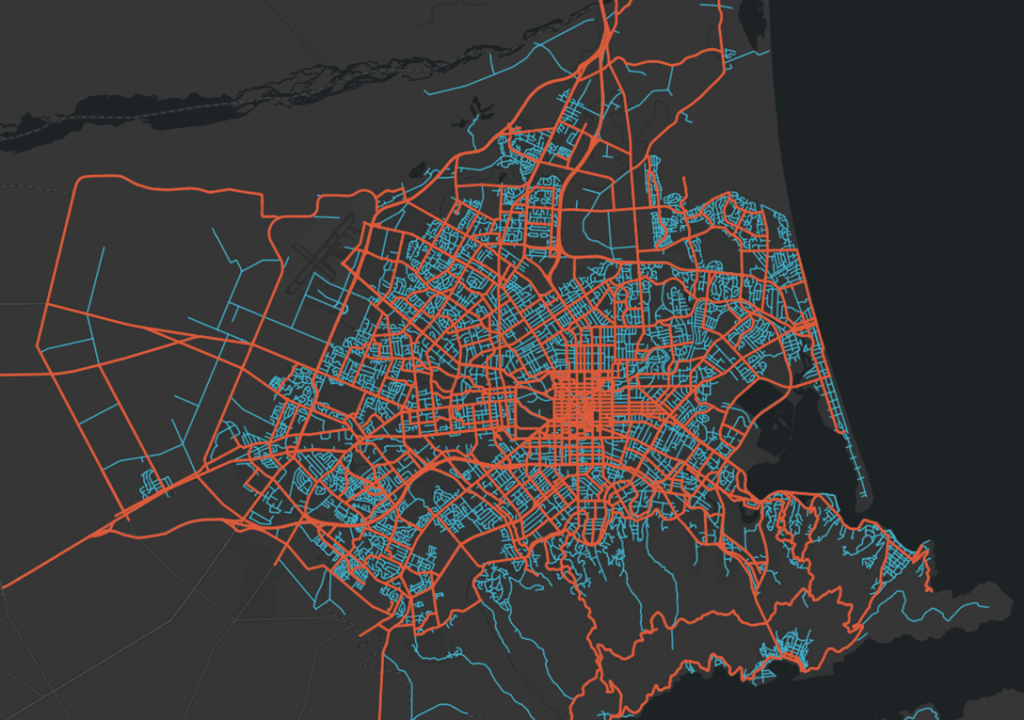

Currently most street design decisions in Christchurch are made at the community board level. This is in between the grass-roots street level and the city councillor level. We think we’re getting the best of both worlds, but I’m starting to wonder if we’re actually getting the worst of both worlds. You don’t get genuine local grass-roots buy-in, but you also don’t get the city councillors who are better informed by the experts about the consequences of their decisions. Our street designs pretty much always end up leaning heavily towards compliance with generic engineering standards, which isn’t legally required but is probably the lowest-risk option if you’re not sure what you should be doing.
My hypothesis is that we’d get better decisions if we devolved the configuration of local streets right down to the people who live and work on that specific street. Conversely, for the strategic network we should elevate decisions to the city councillor level. I talked about this idea briefly in this previous post (just note that the speed limit situation has flipped to the opposite of what that post says – speed limits are now set at a national level, not local).
I’ll caveat this with the fact that, as far as I know, this idea is completely untested and I’ve not heard of any other city that’s done this. But it seems like something worth investigating anyway.
If you and your neighbours could redesign your street however you wanted, what would you do with it?


 TALKING TRANSPORT