
Central government is currently trying to amalgamate local councils into bigger authorities.
It’s complex issue with a lot of water yet to go under the bridge, but one thing I stumbled across that I thought was worth highlighting is a technical memo that Christchurch City Council have recently published on their website.
It was prepared by Heuser-Whittington.
It first talks about some of the principles behind setting boundaries of local government, looking at it mostly through an economic lens. One overarching principle they talk about is that:
“a jurisdiction works best when its boundary matches the area over which a function’s costs and benefits fall”
However they also say that local government performs a range of functions and the relevant area will differ depending on which function you’re talking about:
“A labour market and a housing market span Greater Christchurch; a district plan, a local park or a community facility can serve a smaller community; freshwater, flood and catchment management follow river systems; and some specialist functions reach a regional or national scale. Applied consistently, the principle points to a set of boundaries matched to each function rather than a single jurisdiction drawn around the labour market.”
With that caveat in place, they then go on to talk a lot about the labour market in Christchurch, highlighted with some insightful statistics and charts.
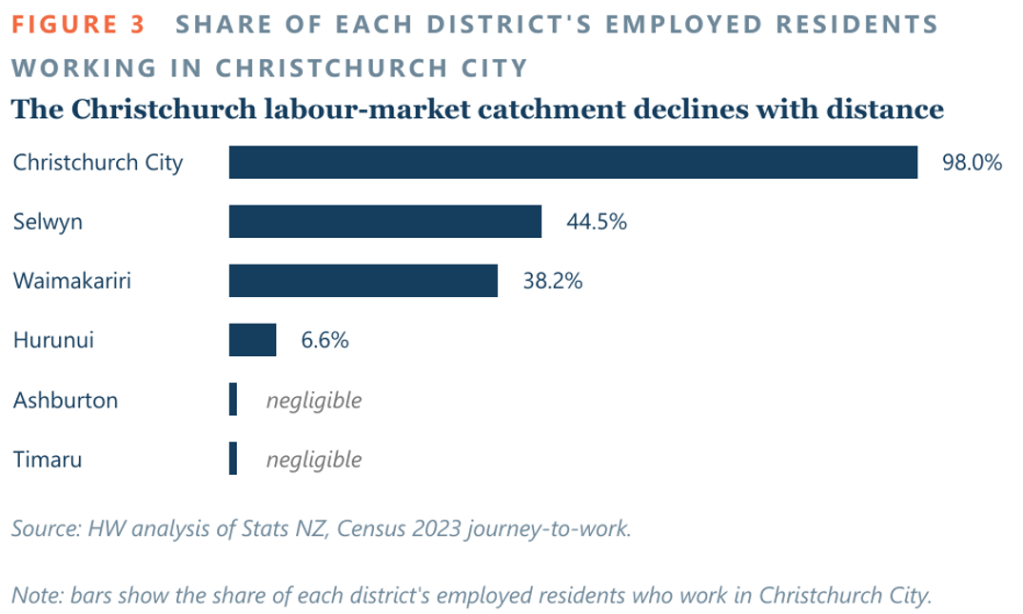
Firstly they show that a lot of Selwyn and Waimakariri residents commute in to Christchurch City for work, but very few from beyond that:
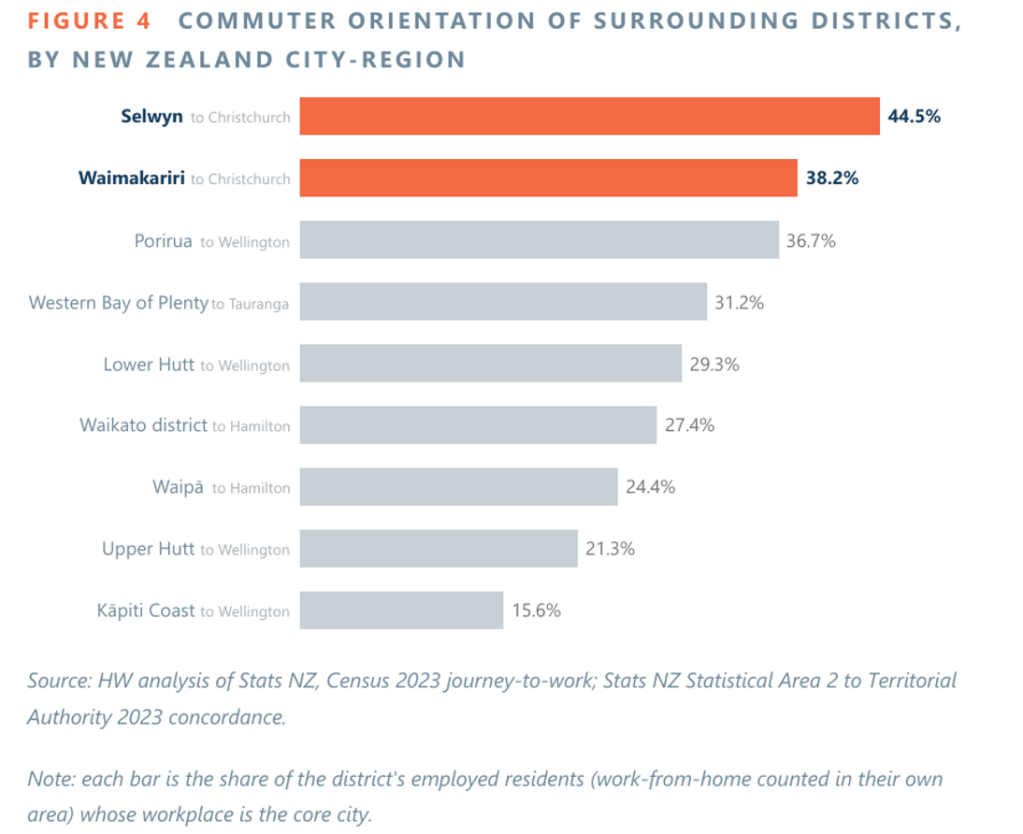
Next they show that these percentages are high by national standards – there are very few districts in the country where anywhere near 35-45% of employed people are travelling to a different district for work.
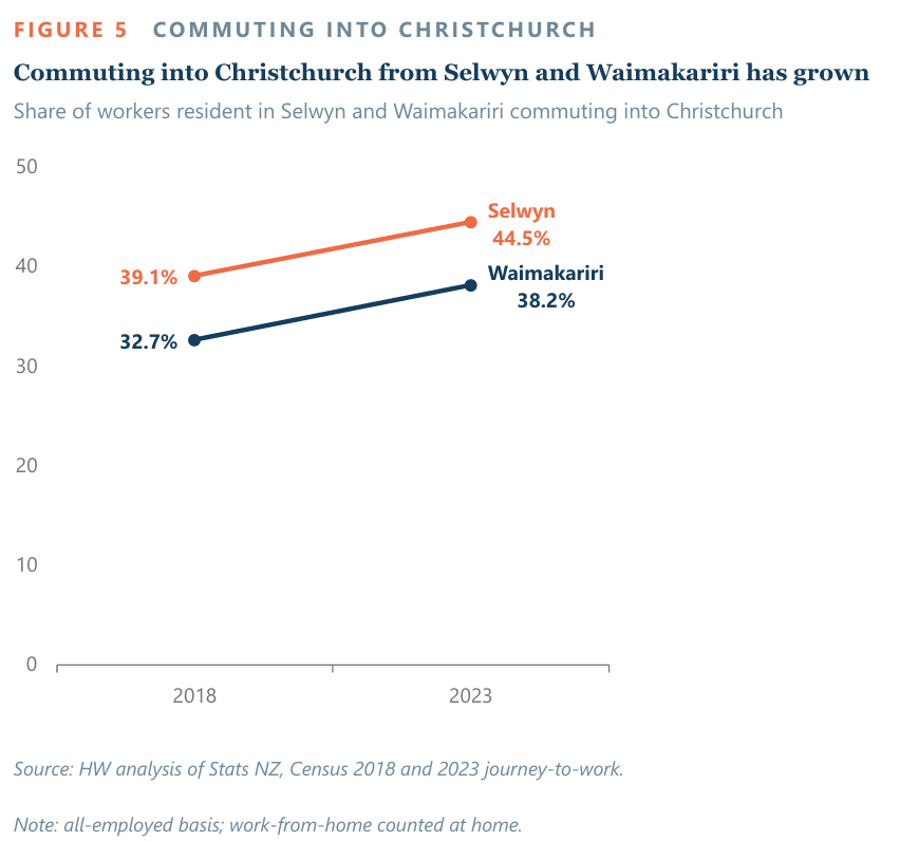
There is a view out there that this is only a temporary phenomenon: as Selwyn and Waimakariri grow then they’ll get more jobs and become more self-reliant, with fewer people commuting into the city.
However, Heuser-Whittington show that this has not been the case in recent years: as Waimakariri and Selwyn have grown, the percentage of workers commuting into the city has gone up, not down.
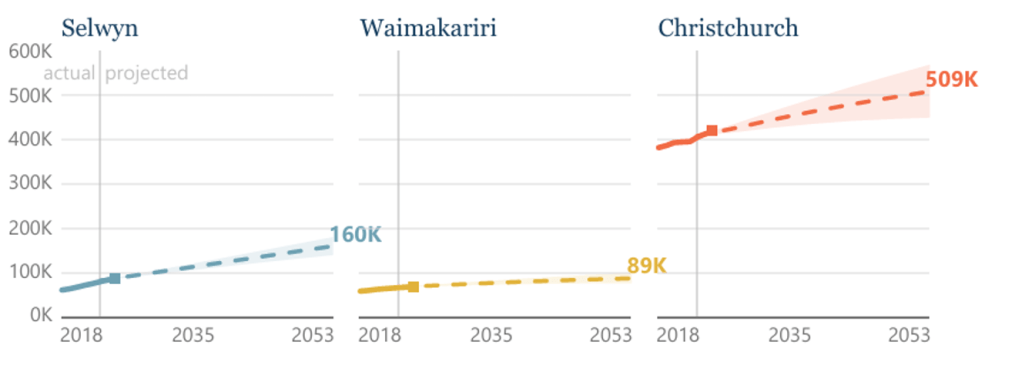
They show population growth in each district. When you look at growth as a percentage of the existing population, then Selwyn has an extemely high growth rate, Waimakariri is also quite high, while Christchurch City is lower. However if you look at the actual numbers of population growth (rather than percentage rate), Christchurch City is growing much faster than either Selwyn or Waimakariri.
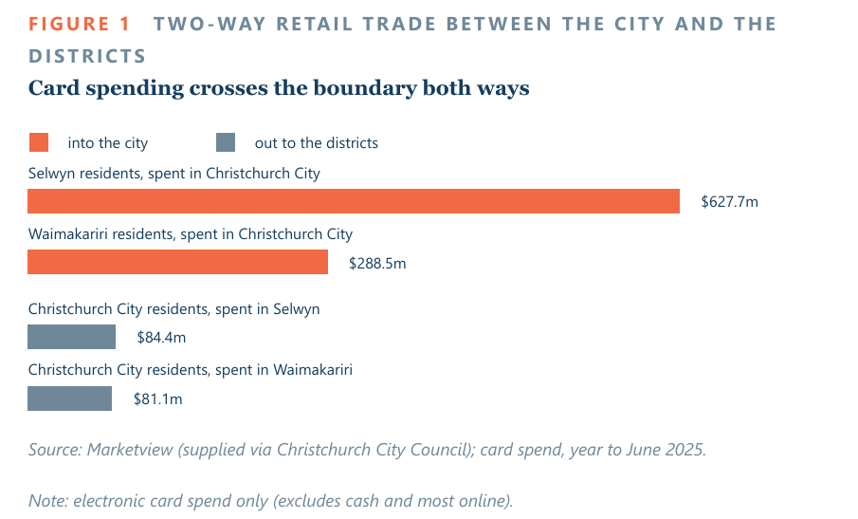
They also look at electronic card spending data. Selwyn and Waimakariri residents spend huge amounts of money in Christchurch City each year. In contrast, Christchurch residents spend hardly anything in Selwyn and Waimakariri.
Finally they look at the employment types in each District, and note that Selwyn and Waimakariri have a higher than average proportion of their jobs in primary industry, and lower than average in services (health, retail, professional, and education). Christchurch City is the complete opposite, with higher than average proportion working in services, and lower in agricultural.
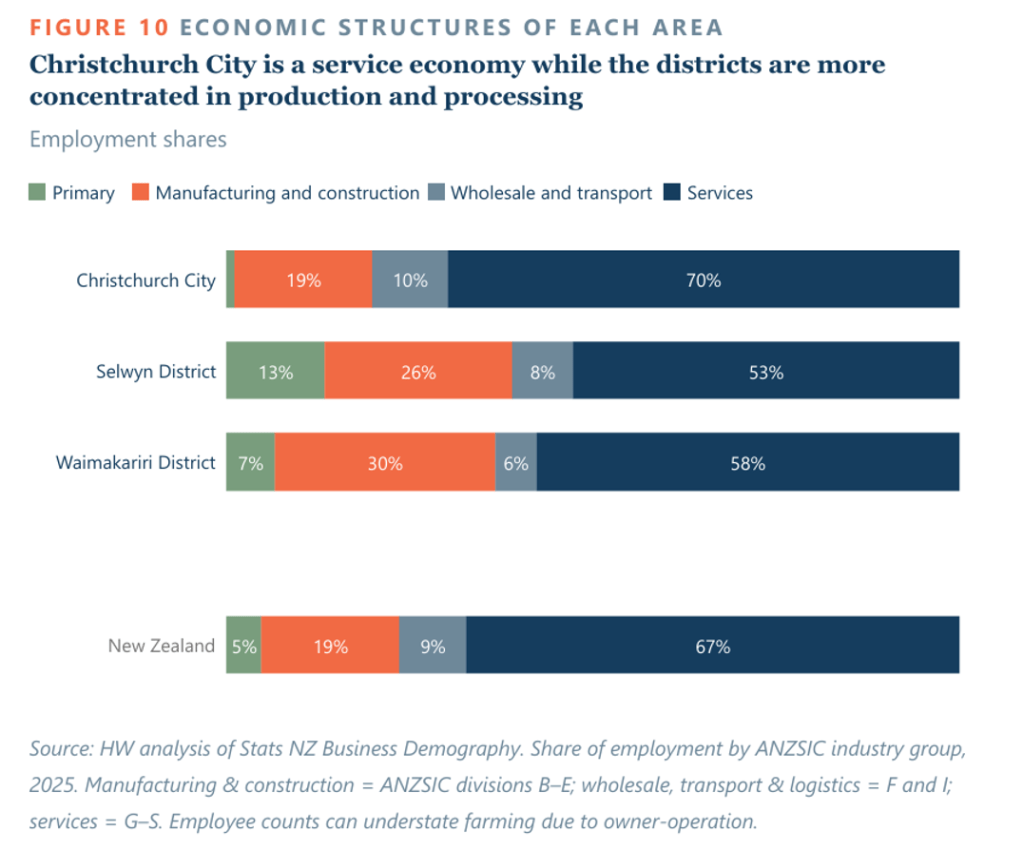
But it includes discussion about how some of these will be different parts of the same supply chain:
“At a high level, produce grown in the districts is processed and manufactured in the city and freighted out through Lyttelton, so the districts’ primary production and the city’s processing, logistics and services are links in one chain.”
In terms of conclusions there weren’t too many in the report, it was more about just setting the scene.
I’m not sure where we’ll end up landing in terms of amalgamation, but I have some thoughts from a transport point of view.
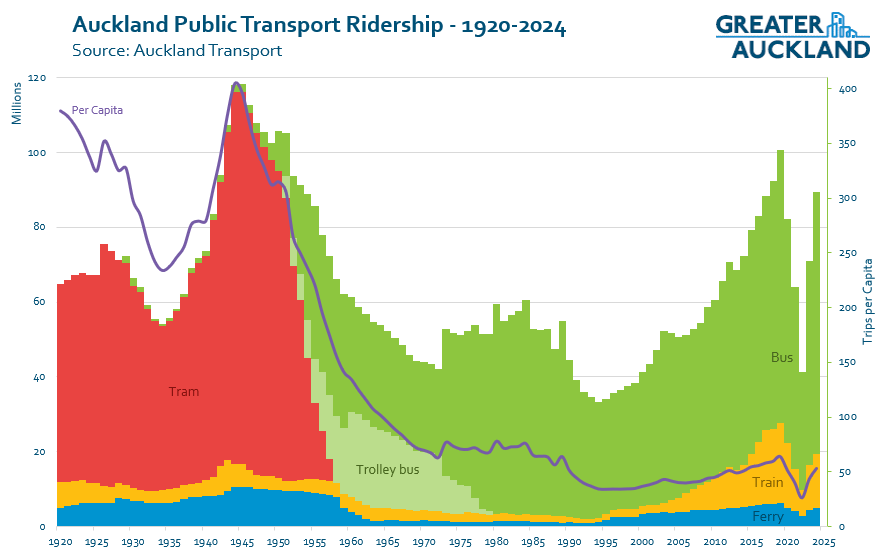
To me, the above information suggests some sort of Greater Christchurch Unitary Authority would be a positive thing for planning and operating our transport networks. In the 16 years since the supercity amalgamation, Auckland’s public transport system been completely transformed, from being a national embarrassment to something actually kind of decent, roughly doubling its patronage in the first decade until covid hit.
I’d love it if our strategic transport network, including all our arterial roads, public transport, and major cycleways, was planned at a Greater Christchurch level. It makes it so hard to do this well when everything is fragmented across four different councils. Public transport especially is problematic in my view, where one council shoulders all the costs (ECan), but it’s the three local councils and Waka Kotahi who reap all the benefits.
In contrast, I’d love to see our non-strategic transport network governed by more local decision-making bodies, perhaps community boards or maybe even something smaller than that. I think letting residents of a small cul-de-sac have a say in how their street is designed and operated would be a great thing and could result in much better outcomes for that community. It has no impact at all on the broader transport network so why not just let the locals make their own choices? There’s no need for a big centralised unitary authority to throw their weight around in that kind of small-scale decision.
So a two-tier system makes sense to me: the strategic transport network needs to be planned at a Greater Christchurch scale, but the non-strategic streets should be delegated down to community boards or even lower.
Anything stand out to you about this?


I wonder what the percentage of people living in each of the old Manukau, Waitakere, and North Shore city council boundaries worked in Auckland city prior to 2010 (or the equivalent areas in 2026). I think it would be a more insightful comparison, although I am genuinely surprised Waimakariri and Selwyn seem to be far more economically dependent on Christchurch city than Lower and Upper Hutt cities are on Wellington city.
On the two-tier system idea – I think something similar was proposed by the Royal Commission looking at Auckland amalgamation and it was not followed through with. I’d prefer a two-tier approach myself for both Christchurch and Wellington, but I don’t hold out much hope. Next best thing is probably to carve out as much responsibility for local boards (where it makes sense) as possible.
I don’t think an imperfect model would be a good enough reason not to go for amalgamation of the two districts and the city. An outcome worse than the status quo would be if Waimakariri went their own way and Selwyn and Christchurch amalgamated. Basically a worse of both worlds scenario.
LikeLike
Yea I’d love to see hte Auckland stats too, and was surprised how low some of the Greater Wellington districts were. Not that surprised by Selwyn and Waimakariri being high though, Rolleston, Lincoln and Kaiapoi all feel to me like residential suburbs of Christchurch rather than standalone towns.
I didn’t really understand that section on Selwyn and Christchurch amalgamating but Waimakariri not. There didn’t seem to be any rationale for it – is it purely a parochial thing?
LikeLike
From what I can tell there has been a lot of push back from Waimakariri more so than Selwyn. It seems to be part parochial (they want to join a North Canterbury council to keep their “identity”) and part fear of increased rates (or “taking on the city’s higher debt levels” as their mayor puts it).
I can’t really see how a ‘Greater Christchurch’ can work without the Waimakariri urban areas being attached. For things like transport it would almost certainly be no improvement – or even a step backwards – on the current situation.
LikeLiked by 1 person
Personally:
a) The amalgamation process is way too rushed. We won’t get good outcomes.
b) There are numerous councils in NZ which are way too small and aren’t financially viable
c) To me it doesn’t make sense 2 different unitary authorities controlling 2 parts of the same river. Ideally, we would use the river catchments as rational boundaries.
d) The water organisations would also align to the same boundaries. There could be more than 1 water authority within a unitary authority area.
e) Auckland has 1.8m people. It’s quite reasonable that the unitary authorities should be large in terms of popualtion
f) There are 17 spatial planning areas proposed in the RMA reforms incl Chatham Islands. Canterbury is one of these.
g) It thus makes sense for Canterbury to be 1 unitary authority of ~700,000 people. Given its size, there would clearly need to be regional offices, sub districts and community boards to provide representation within it.
h) There’s only 1.2m people in the South Island. Tasman, Nelson, Marlborough, Westcoast, Otago, Southland and Chatham Islands could form the other unitary authority of ~550,000 population.
i) Split NI into 5 and retain Auckland = 1.8m pop
j) Greater Wellington = 550,000 pop. Same as the remainder of the SI
k) NI North excl Akl = Northland + Waikato = 740,000 pop, similar to Canterbury
l) NI East Coast – Bay of Plenty, Gisborne, Hawkes Bay = 594,000
m) NI West Coast = Taranaki + Manawatū-Whanganui = 390,000
Alternatively, the NI could be split into 4:
n) Auckland = 1.8m
o) NI North excl Akl = Northland + Waikato = 740,000 pop, similar to Canterbury
p) Central NI = Bay of Plenty + Gisborne + Hawke’s Bay + Taranaki = 723,000
q) Southern NI = Manawatū-Whanganui + Wellington = 814,000
I can’t see this actually happening, as it will be perceived as a step too far. We will probably get a Greater Christchurch which will leave the rural areas not sustainable financially.
Take Canterbury for example:
Greater Christchurch = 550,000, leaving only 150,000 in the rest of the whole of Canterbury, and I cant see the remainder of Canterbury amalgamating as 1 unitary authority.
LikeLike
Wow that would be quite the shake-up!
With unitary authorities that big would you even get any efficiencies though? At that point you’d definitely need smaller councils or community boards sitting below the main council. One council spanning Stewart Island to Tasman to Chatham Islands would be an absolute behemoth, it’d surely require require bureaucracy than now, not less.
LikeLike
Denmark, Norway and Ireland have similar configurations to what’s proposed above, so it is achievable.
LikeLike