I was watching the AM show the other day where they interviewed the Minister of Transport, Simeon Brown. He said something that made me do a double-take:
“In Wellington they found that, actually, and Wellington was the only Council to their credit that actually did a benefit cost analysis, and actually found had a negative of cost analysis so they stopped work on it.”
Simeon Brown, Minister of Transport
I had been loosely following what Wellington was doing with speed limits, but I’d not heard that their benefit-cost ratio was negative, so I wanted to doublecheck that was correct.
Last year, like most cities in NZ, Wellington initiated a piece of work to reduce speed limits around schools. Part of this involved commissioning a transport economist to complete a cost-benefit analysis of various options for reducing speed limits. This is documented in a council report from April 2023, and summarised in the graphic below: https://wellington.govt.nz/-/media/your-council/meetings/committees/kt-environment-and-infrastructure/2023-04-27-agenda-eic.pdf
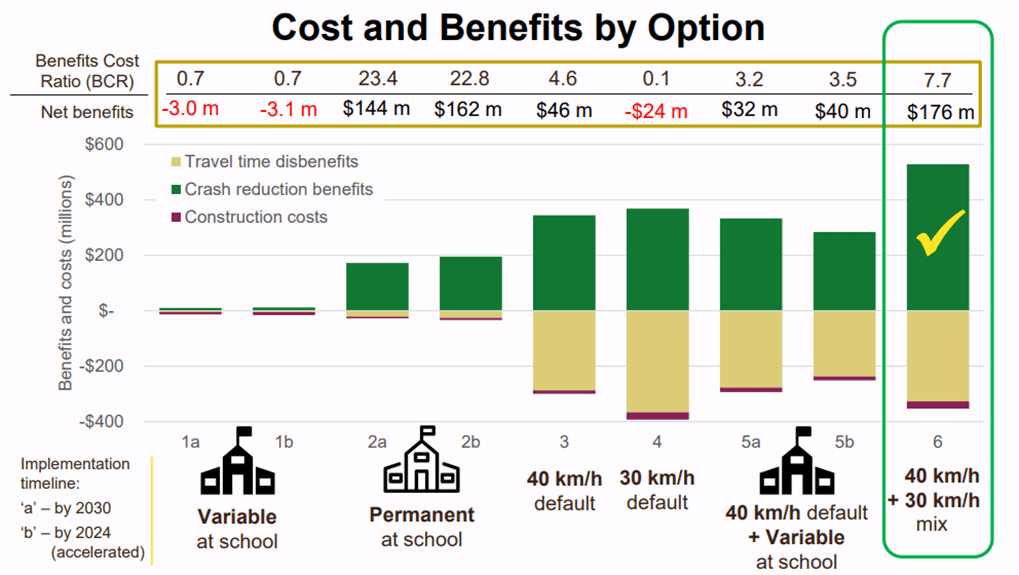
The green bars show that most options would result in a few hundred million dollars in crash reduction benefits. The tan bars show this is partially offset by travel time disbenefits, and some relatively small construction costs (basically just the cost of a whole bunch of signs and markings). For the preferred option the overall result was a Benefit-Cost-Ratio of 7.7. This means society gets back $7.70 benefits for every $1 it spends i.e. an extremely good investment.
Abley noted that they used a conservative methodology. For example they didn’t include any increases to walking and cycling numbers, reduced emissions or vehicle operating cost savings. Ordinarily this would be strange because these are obviously quite important benefits. However I suspect that the BCR being so high was what made them think it didn’t really matter if they skipped that step – all it would mean was the BCR would go from really high to really really high.

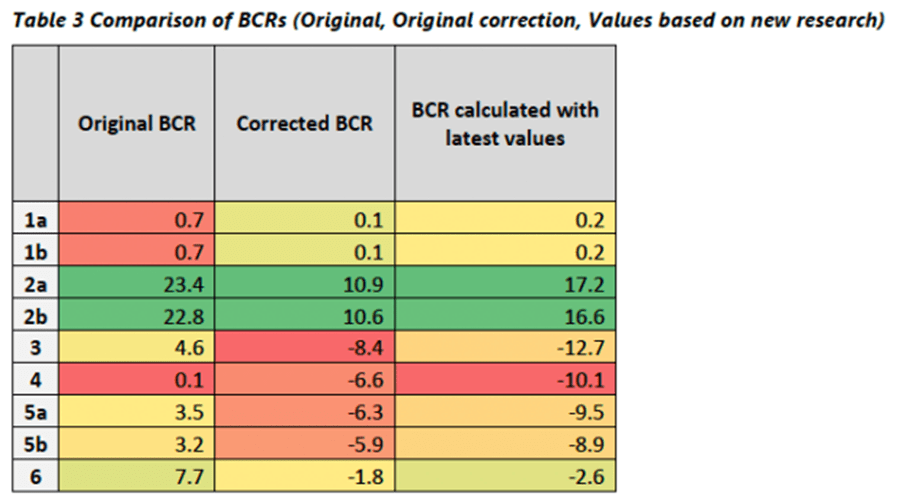
But someone externally then found a calculation error in their spreadsheet. When this error was corrected, the BCR’s all reduced with the preferred option coming back as negative 1.8 (i.e. society loses out on $1.80 in benefits for every $1 spent). In the year or so since the analysis was done, Waka Kotahi had published new values for travel times and value of life. When the BCR was updated to reflect these it came out even worse as negative 2.6. This is all documented in an October council report: https://wellington.govt.nz/-/media/your-council/meetings/committees/audit-and-risk/2023/10/2023-10-11-agenda-unaunahi-mhirahira-audit-and-risk-committee.pdf
So that’s where Simeon Brown got his “negative of cost analysis” from. A part of me was relieved at that, it shows he’s is reading his papers and is at least somewhat interested in basing his policy on evidence.
However it is a big problem that the Wellington calculation excludes any increases to walking and cycling numbers, reduced emissions or vehicle operating cost savings. The transport economist went to great pains to explain this to everyone in the paper. Strangely though, the independent reviewer of the whole shemozzle, Carolyn van Leuven, brushed this comment off because apparently some of the other people she interviewed disagreed.

I wouldn’t mind knowing who said that and on what basis. It is a massive hot-take. It is contrary to what the expert said, contrary to other benefit-cost analysis that I’ve seen, and contrary to just plain common sense. Of course those benefits will be significant.
Auckland
Now to the middle clause of Simeon Brown’s statement: “Wellington was the only Council to their credit that actually did a benefit cost analysis”.
In 2022 Auckland commissioned a different transport economics consultancy to complete cost-benefit-analysis on their speed management programme.
This is referenced in their published plan here: https://at.govt.nz/media/yn4c5owb/242-katoa-ka-ora-auckland-speed-management-plan-2024-2027.pdf
and documented in more detail here: https://at.govt.nz/media/1990950/auckland-transport-speed-management-plan-high-level-economic-assessment.pdf
In contrast to the Wellington economist, the Auckland economist did include mode shift, emissions reduction benefits, and vehicle operating cost savings. These were significant, and overall the programme was assessed as resulting in benefits of $4-7 for each $1 invested.
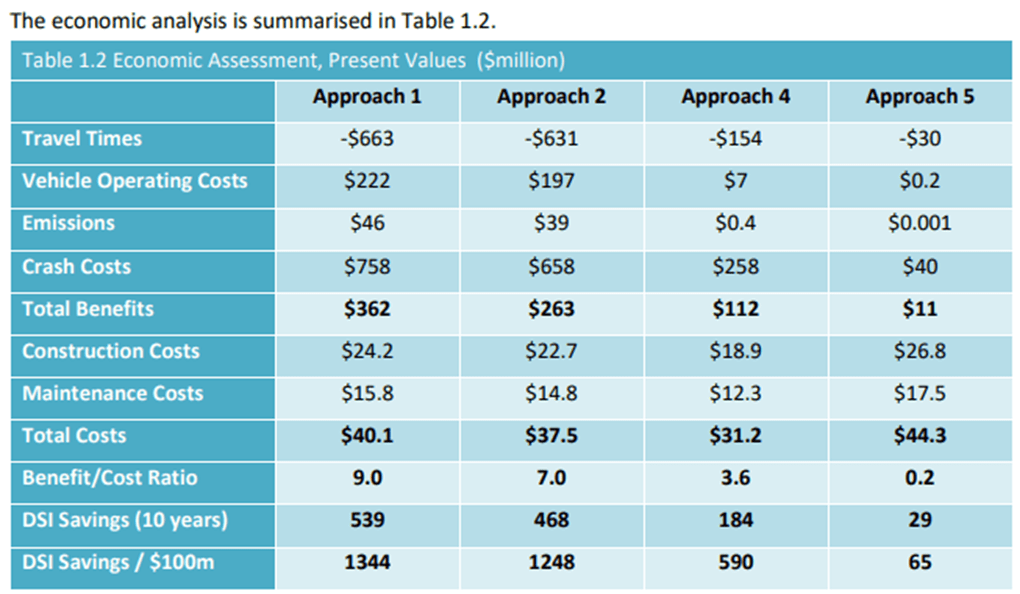
So the middle clause of Simeon Brown’s statement is plainly incorrect – other cities have done benefit-cost analysis for their speed management programmes.
But I also think the rest of the quote is likely wrong as well. The Auckland analysis backs up the economists statement that emissions reduction and vehicle operating cost savings are in fact significant. If Wellington redid their analysis including mode shift then their benefit-cost-ratio would change significantly, and I would expect it to be somewhere in the realms of what was calculated for a reasonably similar scheme in Auckland i.e. a BCR somewhere in the range of 4-7.
For completeness, I would note that there is a broader conversation happening around whether it’s morally defensible even doing benefit-cost-analysis for this sort of project.
When we first introduced a law against murdering people no one weighed up the benefits versus the costs to see if it was economically beneficial: murder was just deemed to be morally unacceptable so it was made illegal, and it’s completely irrelevant what impact on the economy this might have.
Some people argue it’s appropriate to take a similar approach to road safety. We know that having unnecessarily high speed limits kills people, so we have a moral duty to lower them and that’s the end of the story. Whether or not the economics stacks up is completely irrelevant and we shouldn’t even be performing that calculation in case it inadvertantly influences our decision. As such, benefit cost analysis is not required for speed limit changes like these. Wellington and Auckland Council’s choice to do it was just that – their choice.
I’m not sure I necessarily agree with that approach but it’s a moot point anyway. We know that safe speeds around schools are economically beneficial. By now this should be clear to everyone, it’s just unfortunate this whole Wellington BCR muddle has led some people down the wrong path and I suspect it’ll take us quite a few years before the public are convinced again on this topic.
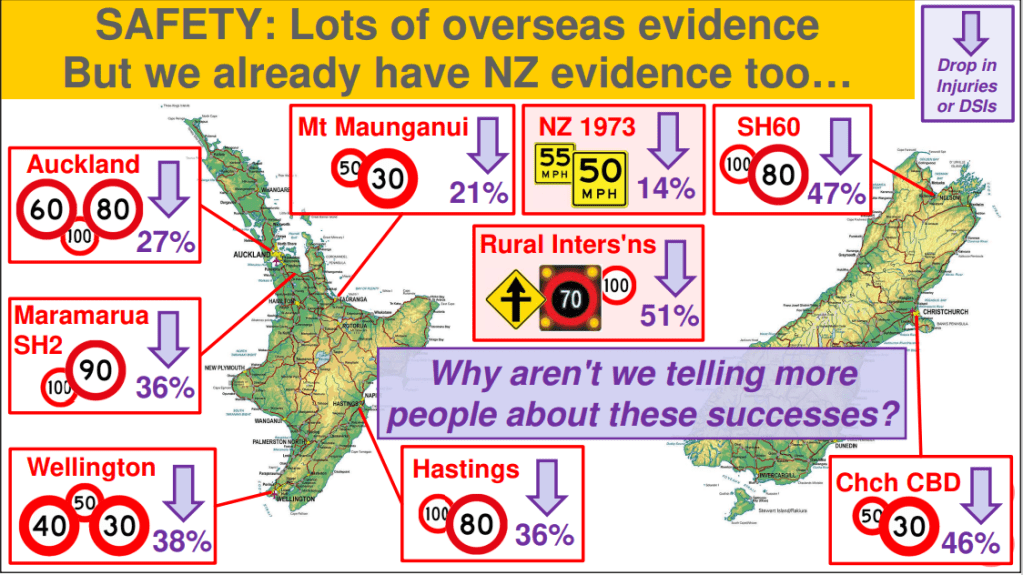
Lastly, if you’re in any doubt that our high speed limits do kill people, have a look at this great presentation from road safety expert Dr Glen Koorey. The summary slide below shows that when we reduce a speed limit, even when it’s by quite a small amount, we tend to see big reductions in deaths and serious injuries:
 TALKING TRANSPORT
Hello Chris, A very good post! Unfortunately we now have a Minister of Transport who cherry picks info that suits his particular view of things. Facts seem irrelevant and his view of things is from the 1950’s. Regards Michael Ball
LikeLiked by 1 person