I’ve recently seen a few things which have made me ponder what a more free market transport system would look like.
Christchurch Hospital Parking
Hospital parking is a perennial favourite topic of conversation at barbecues all over Christchurch. Somewhere in the vicinity of 7,000 people work at the hospital and there’s no way that there will ever be enough car parking for all of them to drive to work. For decades there have been calls for the public sector to spend public funds fixing this, but so far the response has been lukewarm. The private sector sniffed an opportunity, and recently Ngai Tahu Property, the commercial arm of Ngai Tahu, has invested in a seven-storey 463 space car parking building across the road from the hospital. It opened to the public in November 2023, charging customers $24 a day.
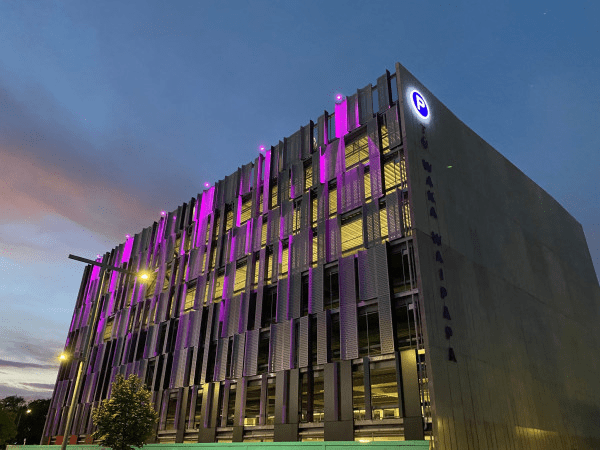
So far, uptake has been minimal. In this article, a nurse was interviewed who said:
“That car park has made absolutely no difference. It’s not a discounted service for staff. It would be $24 a day and frankly, for most staff that is unsustainable, let alone for a lot of patients and their families”
Another interviewee was someone who’d driven their car in for a hospital appointment:
“They could have built a car park somewhere near the hospital that wasn’t going to screw everyone over for an exuberant amount.”
Now this is a privately built facility, operated by a profit-driven company in an industry where there are a lot of players and fairly healthy competition. Ngai Tahu are presumably charging the rate they need to charge to make the investment worthwhile.
But what they have found is that, despite the rhetoric, the demand for car parking at the hospital is minimal at the full cost of $24 per day. Demand only becomes significant if the cost is subsidised, as observed by the highly utilised free on-street parking surrounding the hospital.
Private Toll Road up Mount John
My second example is the University of Canterbury’s working observatory at the top of Mount John, just outside Tekapo. More specifically, the windy, steep, gravel driveway that provides access to it from the public road at the bottom of the hill.
In recent years the observatory has become a popular tourist attraction, with a cafe opening and nightly bus tours operating. The university found they were having to divert increasing amounts of money away from observatory operations to maintain the road. In 2015 a decision was made to start charging a fee for vehicles to use the road, with that money used to pay for the road maintenance. It was initially $5 per car, this was raised to $8 in 2018 and $10 in 2023.
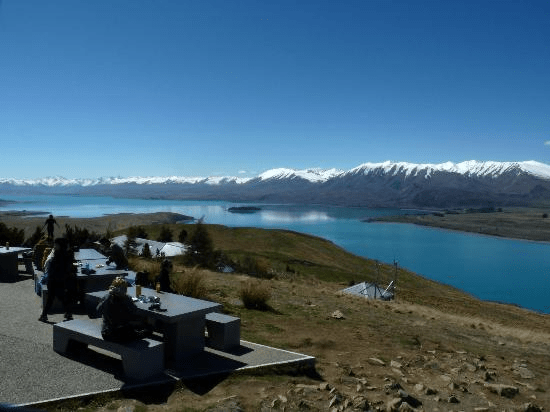
I went to Tekapo last weekend with a bunch of friends, and we talked about heading up the hill to take in the spectacular views over a nice flat white. The ensuing conversation was an economist’s dream. Some of us were happy to pay the $10 toll to drive up, while others refused. Some thought the free walking track was a better option, while others didn’t. A quick look on Trip Advisor shows mixed reviews on the road toll. Some hate it:
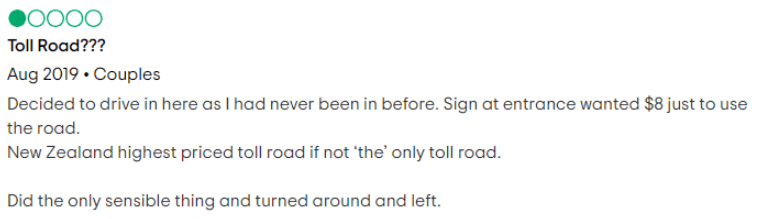
The majority though don’t seem to mind too much:

In the end our decision was made for us – when the half of us who were willing to pay the toll got to the bottom of the road we were turned away because the hilltop car-park was full.
Clearly plenty of others were willing to pay the toll.
Te Waihanga (Infrastructure Commission) research
Thirdly, Te Waihanga (Infrastructure Commission) recently published research on what New Zealanders think is fair when it comes to paying for infrastructure (here).
Amongst other things, they asked a whole bunch of people if they thought it was fair for people to get charged for their electricity, water and road use by how much they use. The vast majority said it’s fair to pay for electricity by how much you use, and even water as well. But only about a third thought the same was true of roads.
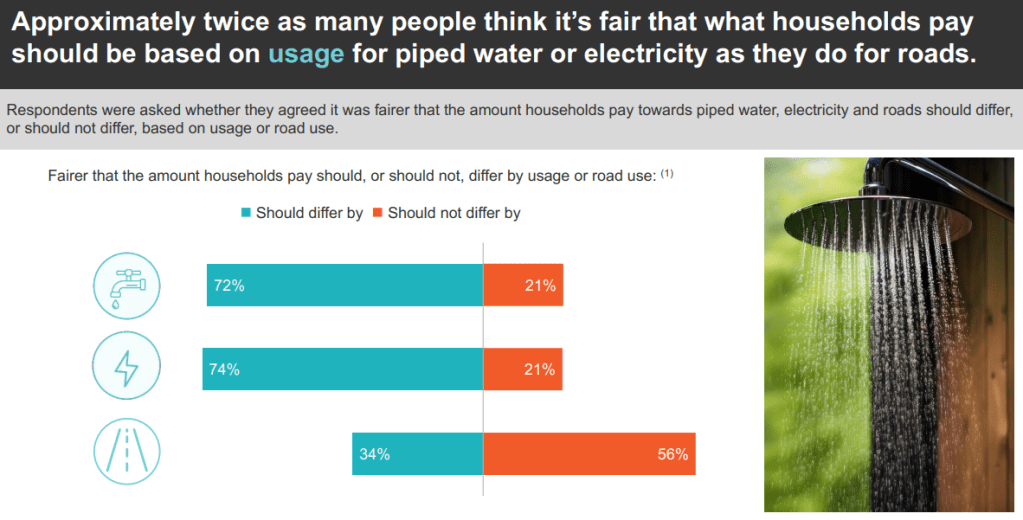
I thought this was really interesting. Why do New Zealanders have such a different attitude to roads than we do power lines and pipes?
I read through the report and, as always, there is a bit more nuance to it. The actual question was about time of use rather than the quantity of use:
“The following question is about when people use roads. At times of high demand (i.e. peak), roads can get very busy. One way to manage this (and avoid congested roads) is to charge for using these roads at high demand (peak) times. This encourages households to drive less at these times by changing their time of travel, their route, or the way they travel.”
The question was also also solely asking about use of the roads on the occasions when you’re inside a car: not on foot, on bike or on a bus; but this wasn’t initially obvious from the reporting.
I find this quite interesting. For what it’s worth I’ve jotted down some musings below.
There’s something primal about being free to move around. Freedom of movements is one of the key articles in the universal declaration of human rights, and people are repelled by the idea of restricting movement in any way. We saw this through covid lockdowns, we see it whenever private landowners try to block public access to things like beaches and lakes. Walking access is something that has been publicly provided free of charge in just about every culture throughout all of recorded history. Historically I’d say this has worked reasonably well, because walking access doesn’t require a lot of space and virtually no infrastructure.
In modern times however, we’ve extended this concept of free access to include access by car. But car access is far more difficult to provide, requiring more land, more expensive infrastructure, and resulting in all sorts of negative externalities which we still haven’t figured out how to deal with satisfactorily (pollution, congestion, noise, crashes, emissions). As such, it’s led to much bigger problems.
We could solve a lot of our infrastructure problems if we retained the concept of free and unrestricted walking access for all, but walked back the recent extension to free and unrestricted vehicle access for all. If people want to access by car then they should pay the full cost of providing that, not expect society to provide them with free and unrestricted car access as a human right.
So what would a more free-market transport system look like? I don’t know the full picture but these little illustrations would suggest three things at least:
- If people had to pay a market rate for car parking, most people probably wouldn’t drive, at least not in city centres where parking is expensive to provide.
- If people had to pay a market rate for roads, some would still drive but at least some would not.
- Even if we shifted more towards a more free-market system for cars, we never could for pedestrians. Freedom of movement is something that’s enshrined deeply in our collective psyche, and I suspect we will always allow free and unrestricted access on our streets for people on foot.
 TALKING TRANSPORT
If NZTA WK was able to work out road user charges based on the damage one’s vehicle does to the roads, then all large vehicle users would face large cost increases.
LikeLike